SPECIALIST SERVICES
Specialist Pain Medicine & Rehabilitation at Modern Physiotherapy Clinic
Specialist medical insight. Advanced rehabilitation. One connected pathway.
Specialist Pain Medicine and advanced physiotherapy rehabilitation together at Modern Physiotherapy Clinic in Ascot Vale.
Persistent and complex pain can require more than one perspective
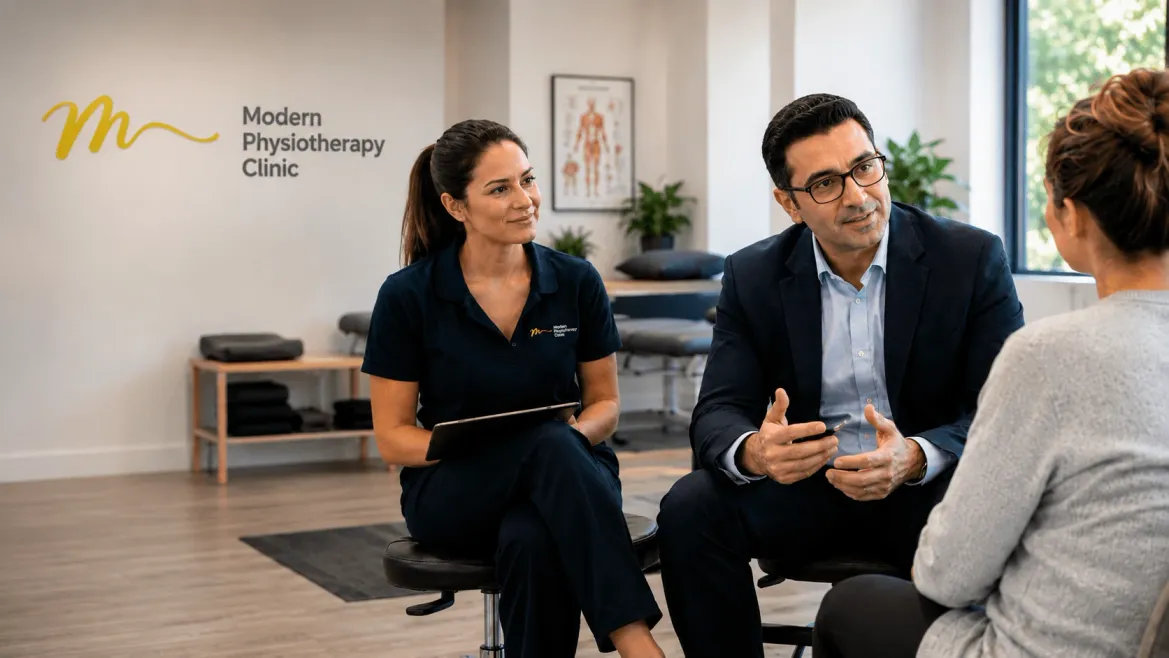
At Modern Physiotherapy Clinic, our integrated pain medicine and rehabilitation service brings Specialist Pain Medicine and advanced physiotherapy rehabilitation together within one clinical environment.
Our approach combines specialist medical assessment with Modern Physiotherapy Clinic’s established focus on movement, function and rehabilitation — creating a more connected pathway for people living with persistent, complex, spinal, neuropathic and musculoskeletal pain.
Dr Mohammad Jabbarpour | MBBS, FRACGP, FFPMANZCASpecialist Pain Medicine PhysicianConsulting at Modern Physiotherapy Clinic, Ascot Vale
Pain Medicine Meets Rehabilitation
A different way of approaching persistent pain
Pain does not always come from one structure, one injury or one identifiable finding on a scan.
For some people, pain continues despite treatment. For others, it begins to affect movement, physical capacity, sleep, work, confidence and participation in everyday life.
This is where a broader approach may be valuable.
At Modern Physiotherapy Clinic, our philosophy is to look beyond pain in isolation and consider the whole pathway from specialist assessment to function and rehabilitation.
Specialist Pain Medicine can provide the medical perspective.
Physiotherapy can address movement, physical function, rehabilitation and return to activity.
Where both are clinically appropriate, communication between practitioners can help create a clearer and more coordinated pathway around the patient.
This is the foundation of Modern Physiotherapy Clinic Integrated Pain Medicine & Rehabilitation.
For some people, pain continues despite treatment. For others, it begins to affect movement, physical capacity, sleep, work, confidence and participation in everyday life.
This is where a broader approach may be valuable.
At Modern Physiotherapy Clinic, our philosophy is to look beyond pain in isolation and consider the whole pathway from specialist assessment to function and rehabilitation.
Specialist Pain Medicine can provide the medical perspective.
Physiotherapy can address movement, physical function, rehabilitation and return to activity.
Where both are clinically appropriate, communication between practitioners can help create a clearer and more coordinated pathway around the patient.
This is the foundation of Modern Physiotherapy Clinic Integrated Pain Medicine & Rehabilitation.
Our Integrated Pain Pathway
Understand. Plan. Rehabilitate. Review.
1. Understand
The first step is understanding the person behind the pain.
Depending on your needs, this may begin with a Specialist Pain Medicine consultation, physiotherapy assessment or your existing treating practitioner.
The aim is to understand your history, symptoms, previous investigations and treatment, medications, functional limitations and the effect pain is having on your life.
Depending on your needs, this may begin with a Specialist Pain Medicine consultation, physiotherapy assessment or your existing treating practitioner.
The aim is to understand your history, symptoms, previous investigations and treatment, medications, functional limitations and the effect pain is having on your life.
2. Plan
There is no single treatment for persistent pain.
An individual management strategy is developed according to your presentation, medical needs, functional goals and the factors contributing to your pain.
Recommendations may include medical management, education, self-management strategies, rehabilitation or involvement of other healthcare professionals where appropriate.
An individual management strategy is developed according to your presentation, medical needs, functional goals and the factors contributing to your pain.
Recommendations may include medical management, education, self-management strategies, rehabilitation or involvement of other healthcare professionals where appropriate.
3. Rehabilitate
When rehabilitation forms part of your management plan, our physiotherapists can independently assess your movement, physical capacity and rehabilitation requirements.
Treatment may involve education, graded movement, strength and conditioning, functional rehabilitation and selected non-invasive technologies where clinically appropriate.
4. Review & Coordinate
Pain management often changes as function, symptoms and circumstances change.
Where clinically appropriate and with patient consent, communication between the Specialist Pain Medicine Physician, physiotherapist, GP and other treating practitioners can help keep care coordinated and focused on meaningful progress.
The goal is not simply to treat pain. It is to help build a pathway forward.
When Should You Consider Seeing a Pain Specialist?
A Specialist Pain Medicine consultation may be appropriate when pain:
- Has persisted beyond the expected period of recovery
- Is affecting work, sleep, mobility, exercise or everyday activities
- Has not responded as expected to previous treatment
- Is preventing progress with rehabilitation
- Has become recurrent or difficult to manage
- Involves burning, shooting pain, tingling, hypersensitivity or other nerve-related symptoms
- Is associated with a complex medical or musculoskeletal presentation
- Requires a broader review of current management or medications
- Is affecting multiple areas of function or quality of life
You do not need to have exhausted every other treatment before discussing whether Specialist Pain Medicine assessment may be appropriate.
Meet Our Consulting Specialist
Dr Mohammad Jabbarpour MBBS, FRACGP, FFPMANZCA Specialist Pain Medicine Physician
Dr Mohammad Jabbarpour is a Specialist Pain Medicine Physician with a particular interest in comprehensive, multidisciplinary and rehabilitation-focused approaches to pain management.
He completed his advanced Pain Medicine training at Royal Hobart Hospital and is a Fellow of the Faculty of Pain Medicine, Australian and New Zealand College of Anaesthetists (FFPMANZCA). Dr Jabbarpour’s clinical interests include persistent and chronic pain, spinal pain, neuropathic pain, complex regional pain syndrome (CRPS), musculoskeletal pain, pelvic pain, cancer-related pain and other complex pain presentations. Dr Jabbarpour takes a holistic, evidence-based and biopsychosocial approach to pain management, with a strong focus on understanding the factors contributing to each patient’s pain, improving function and supporting meaningful and sustainable recovery.With a background in General Practice and advanced specialist training in Pain Medicine, Dr Jabbarpour brings a broad and comprehensive perspective to the assessment and management of acute, persistent and complex pain. He values close collaboration with physiotherapists and other health professionals, combining specialist medical assessment with rehabilitation, movement, interventional treatments and other contemporary pain management options where clinically appropriate. At Modern Physiotherapy Clinic, this collaborative approach allows patients to access specialist Pain Medicine alongside physiotherapy and rehabilitation services within the same clinical environment, supporting better communication between practitioners and a more coordinated pathway of care. He believes that effective pain management often requires an individualised combination of treatment strategies. Depending on the patient’s condition and clinical needs, this may include medication optimisation, rehabilitation, movement and physical therapies, psychological strategies, and interventional pain procedures where clinically appropriate. Dr Jabbarpour is supportive of procedural treatment in appropriately selected patients and believes that diagnostic and therapeutic interventions can form an important part of a broader pain management plan when there is a clear clinical indication. His goal is to help patients not only better manage their pain, but also improve their function, confidence and quality of life.
More Than a Specialist Consultation
Dr Jabbarpour’s service at Modern Physiotherapy Clinic will initially be consultation-based. Where an interventional procedure is clinically appropriate, the appropriate treatment pathway and location can be discussed as part of the patient’s management plan.
- Access to Modern Physiotherapy Clinic's established rehabilitation environment
One of the distinguishing features of Specialist Pain Medicine at Modern Physiotherapy Clinic is access to an established physiotherapy and rehabilitation environment within the same location.
Modern Physiotherapy Clinic's rehabilitation approach may include:
Physiotherapy & Clinical Rehabilitation
Individual physiotherapy assessment, education, movement rehabilitation, progressive exercise, strength and conditioning and return-to-function planning.
Where physiotherapy forms part of a patient's management, Modern Physiotherapy Clinic provides individual Physiotherapy Pain Management and Rehabilitation focused on movement, physical capacity and function.
Advanced Movement & Functional Assessment
Depending on the presentation, assessment may incorporate gait analysis, movement assessment and real-time ultrasound biofeedback.
Contemporary Non-Invasive Technologies
Following an independent physiotherapy assessment, selected patients may be considered for technologies such as:
- Focused Shockwave Therapy
- Radial Shockwave Therapy
- EMTT® – Extracorporeal Magnetotransduction Therapy
- TECAR Therapy
- High Intensity Laser Therapy
- Low Level Laser Therapy
- Electrotherapy
- Ultrasound Therapy
These services are not automatically part of Specialist Pain Medicine treatment.
They are considered independently by the treating physiotherapist and used only where clinically appropriate for the patient's presentation and rehabilitation goals.
The technology supports the rehabilitation pathway.
The patient remains at the centre of the pathway.
They are considered independently by the treating physiotherapist and used only where clinically appropriate for the patient's presentation and rehabilitation goals.
The technology supports the rehabilitation pathway.
The patient remains at the centre of the pathway.
Two Disciplines. One Clinical Environment.
- Better opportunity for connected care
A patient living with persistent pain may require different forms of care at different stages.
Some patients may only require Specialist Pain Medicine assessment.
Others may only require physiotherapy.
Some may benefit from both.
At Modern Physiotherapy Clinic, these services are available within the same clinical environment while remaining professionally and clinically independent.
Where collaboration is appropriate and the patient consents, this can facilitate communication about:
Some patients may only require Specialist Pain Medicine assessment.
Others may only require physiotherapy.
Some may benefit from both.
At Modern Physiotherapy Clinic, these services are available within the same clinical environment while remaining professionally and clinically independent.
Where collaboration is appropriate and the patient consents, this can facilitate communication about:
- Medical assessment and management
- Pain-related barriers to rehabilitation
- Movement and functional progress
- Rehabilitation goals
- Return to activity or work
- Response to management
- Need for further review or referral
This provides the opportunity for a more connected patient journey without removing the patient's freedom to choose their treating practitioners.
Pain Presentations We Can Assess
Persistent & Chronic Pain
Pain that continues beyond expected recovery and begins affecting activity, independence or quality of life.
Back & Spinal Pain
Persistent lower back, neck and spinal pain, including complex or recurrent presentations and Persistent Spinal Pain Syndrome.
Neuropathic Pain
Nerve-related pain that may involve burning, shooting, electric sensations, tingling, altered sensation or hypersensitivity.
Complex Regional Pain Syndrome
Specialist assessment and management of CRPS and associated complex pain presentations.
Musculoskeletal Pain
Persistent pain affecting muscles, joints and other musculoskeletal structures, particularly where recovery has become prolonged or complex.
Pelvic Pain
Persistent or complex pelvic pain requiring broader medical assessment and coordinated management.
Cancer-Related Pain
Assessment and management of pain related to cancer or cancer treatment within the patient's wider medical care.
Complex Pain Presentations
Pain involving multiple contributing factors, previous treatments or health conditions where a broader assessment may assist with future management.
What Happens at Your First Specialist Consultation?
The initial consultation provides time to understand your history in detail rather than focusing only on where you hurt.
Your consultation may include:
- Your Pain Story
When symptoms began, how they have changed and how pain currently affects your life.
Previous Investigations & Treatment
Relevant imaging, specialist reports, previous treatment and rehabilitation can be reviewed.
Medical & Medication Review
Your relevant medical history and current medications may be considered as part of the assessment.
Function & Quality of Life
How pain affects work, sleep, movement, exercise, family life and activities that matter to you.
Clinical Assessment
An appropriate examination may be performed depending on your presentation.
Your Goals
Understanding what you want to regain or improve is an important part of planning care.
Your Management Plan
Dr Jabbarpour will discuss his assessment and recommendations with you and, where appropriate, coordinate with your referring practitioner and other healthcare professionals involved in your care.
Rehabilitation That Starts With the Individual
Pain rehabilitation is not simply about making a painful area stronger.
Persistent pain can change how people move, what they avoid, how confident they feel about activity and how much physical capacity they have lost over time.
When physiotherapy rehabilitation is appropriate, the focus may include:
Persistent pain can change how people move, what they avoid, how confident they feel about activity and how much physical capacity they have lost over time.
When physiotherapy rehabilitation is appropriate, the focus may include:
- Understanding pain and the condition
- Restoring comfortable movement
- Building strength and physical capacity
- Graded return to activity
- Improving confidence with movement
- Reducing barriers to rehabilitation
- Developing self-management strategies
- Supporting return to work, sport or everyday function
Treatment is individualised rather than built around a predetermined modality or device.
For GPs & Referring Practitioners
A specialist pathway with rehabilitation close at hand
Modern Physiotherapy Clinic welcomes referrals for Specialist Pain Medicine assessment.
Dr Mohammad Jabbarpour consults at Modern Physiotherapy Clinic as a Specialist Pain Medicine Physician and assesses patients independently within his medical scope of practice.
Modern Physiotherapy Clinic can provide an additional advantage for patients who also require physiotherapy or physical rehabilitation: an established rehabilitation service is available within the same clinical environment.
Where clinically appropriate and with the patient's consent, this can facilitate communication between the specialist, physiotherapist and referring practitioner.
Patients remain free to undertake rehabilitation with their existing physiotherapist or another provider.
Dr Mohammad Jabbarpour consults at Modern Physiotherapy Clinic as a Specialist Pain Medicine Physician and assesses patients independently within his medical scope of practice.
Modern Physiotherapy Clinic can provide an additional advantage for patients who also require physiotherapy or physical rehabilitation: an established rehabilitation service is available within the same clinical environment.
Where clinically appropriate and with the patient's consent, this can facilitate communication between the specialist, physiotherapist and referring practitioner.
Patients remain free to undertake rehabilitation with their existing physiotherapist or another provider.
Referrals may be considered for patients experiencing:
- Persistent or complex pain
- Neuropathic pain
- Spinal pain
- CRPS
- Musculoskeletal pain
- Pelvic pain
- Cancer-related pain
- Pain interfering with rehabilitation or return to function
[REFER A PATIENT]
[CONTACT OUR RECEPTION TEAM]
[CONTACT OUR RECEPTION TEAM]
Referrals & Medicare
A valid medical referral is generally required for a patient to access a Medicare rebate for a specialist consultation.
A GP referral to a specialist is generally valid for 12 months from the date of the patient's first consultation with the specialist unless the referring practitioner specifies another period.
Patients can contact our reception team if they are unsure what documentation is required for their appointment.
A GP referral to a specialist is generally valid for 12 months from the date of the patient's first consultation with the specialist unless the referring practitioner specifies another period.
Patients can contact our reception team if they are unsure what documentation is required for their appointment.
What Should I Provide Before My Appointment?
Where available and relevant, please provide:
- Your medical referral
- Relevant MRI, CT, X-ray or ultrasound reports
- Previous specialist reports
- Hospital or surgical reports
- A current medication list
- Relevant pathology or investigation results
- Information about previous treatment and rehabilitation
You do not need to arrange new investigations simply to attend your first consultation unless your referring or treating doctor has specifically requested them.
Specialist Pain Medicine Appointments at Modern Physiotherapy Clinic
Dr Mohammad JabbarpourMBBS, FRACGP, FFPMANZCASpecialist Pain Medicine Physician
Consulting at:
Modern Physiotherapy Clinic189 Maribyrnong RoadAscot Vale VIC 3032
Appointments are available through Modern Physiotherapy Clinic.
View current appointment availability online or contact our reception team.
Phone: (03) 9375 7212
Consulting at:
Modern Physiotherapy Clinic189 Maribyrnong RoadAscot Vale VIC 3032
Appointments are available through Modern Physiotherapy Clinic.
View current appointment availability online or contact our reception team.
Phone: (03) 9375 7212
Frequently Asked Questions
Is a pain specialist the same as a Specialist Pain Medicine Physician?
“Pain specialist” is a commonly used patient-friendly description. The recognised specialist title for this medical specialty is Specialist Pain Medicine Physician.
- Do I need a referral?
A valid referral is generally required to receive a Medicare rebate for a specialist medical consultation.
If you are unsure about your referral, contact Modern Physiotherapy Clinic reception before your appointment.
Do I need to be an existing Modern Physiotherapy Clinic patient?
No.
Specialist Pain Medicine consultations are available to new patients as well as existing Modern Physiotherapy Clinic patients.
Will I automatically receive physiotherapy?
No.
Specialist Pain Medicine and physiotherapy are separate clinical services.
Physiotherapy may form part of a management plan where clinically appropriate, but patients retain the freedom to choose where they receive their rehabilitation.
Specialist Pain Medicine and physiotherapy are separate clinical services.
Physiotherapy may form part of a management plan where clinically appropriate, but patients retain the freedom to choose where they receive their rehabilitation.
Do I need to have physiotherapy before seeing the pain specialist?
Not necessarily.
The appropriate pathway depends on your circumstances, symptoms and referral.
Does the pain specialist provide Shockwave, EMTT®, TECAR or Laser Therapy?
These technologies form part of Modern Physiotherapy Clinic's physiotherapy and rehabilitation services rather than the specialist medical consultation.
Where appropriate, one of our physiotherapists independently assesses whether a particular rehabilitation treatment or technology may be suitable.
Can my GP refer me directly?
Yes. Medical practitioners can refer patients for Specialist Pain Medicine assessment.
Our reception team can provide the relevant clinic and provider details required for referral.
Can my existing physiotherapist remain involved?
Yes.
Patients do not need to transfer their physiotherapy care to Modern Physiotherapy Clinic in order to see the Specialist Pain Medicine Physician.
With patient consent, relevant communication can occur between treating practitioners where appropriate.
Patients do not need to transfer their physiotherapy care to Modern Physiotherapy Clinic in order to see the Specialist Pain Medicine Physician.
With patient consent, relevant communication can occur between treating practitioners where appropriate.
Pain Medicine Meets Rehabilitation
Persistent pain can be complex.
The pathway forward should not have to be.
Modern Physiotherapy Clinic integrated pain medicine and rehabilitation brings Specialist Pain Medicine and advanced physiotherapy rehabilitation into one clinical environment — giving patients access to medical assessment, rehabilitation expertise and contemporary non-invasive treatment options while keeping care individualised and clinically appropriate.
The pathway forward should not have to be.
Modern Physiotherapy Clinic integrated pain medicine and rehabilitation brings Specialist Pain Medicine and advanced physiotherapy rehabilitation into one clinical environment — giving patients access to medical assessment, rehabilitation expertise and contemporary non-invasive treatment options while keeping care individualised and clinically appropriate.
Modern Physiotherapy Clinic
189 Maribyrnong Road, Ascot Vale VIC 3032(03) 9375 7212
OUR APPROACH TO CARE
Core values we bring to your care
> Understand the problem
We take the time to understand your history, symptoms, goals and the factors that may be contributing to your presentation.
> Provide individualised care
Care is guided by clinical assessment, your individual needs and your goals.
> Support your healthcare journey
Where appropriate, we communicate with other treating healthcare professionals to help support coordinated care.